
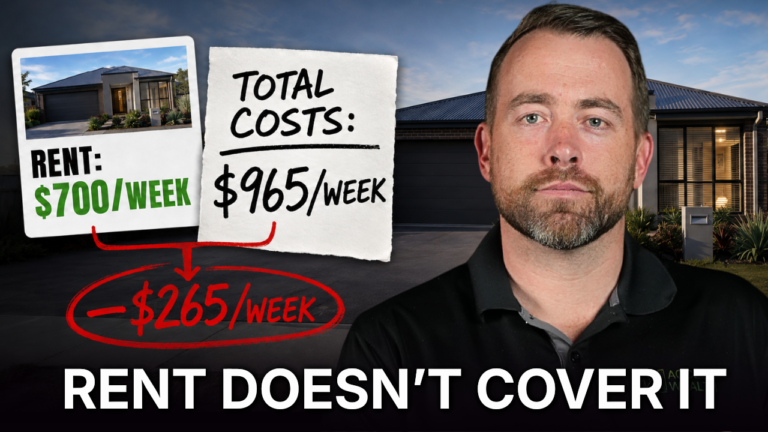
A good property purchase shouldn’t come down to a gut feeling. The common belief is that buying well comes down to a good location, a nice-looking place, or a hot tip from a mate who knows the area. But whether a property builds you wealth or drains you in the background comes down to some maths: the cash flow, the holding costs, your borrowing capacity, and the real-life growth drivers. If those numbers don’t stack up conservatively, it’s not a good deal, no matter how good it looks at the open home.
We cover this in a recent episode of our podcast, Inside Access Property — a deep dive into the Protect pillar from our 5-Pillar Blueprint, since it’s the stage where most people either get it right, or set themselves up to fail. This post walks through the same worked example in more detail.
Start with what you can actually afford, not the maximum a bank will approve
The starting point isn’t the maximum amount a bank is willing to lend you, it’s understanding what you or your family can comfortably afford to hold on a weekly or monthly basis. A bank’s number tells you the ceiling. It doesn’t tell you what’s actually comfortable to live with, and those two numbers are often very different.
Property isn’t a get-rich-quick scheme. It doesn’t double overnight. To get anything meaningful out of it, you need to be in the market for a decent stretch of time, and none of that matters if you can’t afford to hold the property in the first place.
Two questions before you even look at a property
- 1Can I actually get a loan?Unless you’ve got a spare $700,000 sitting in cash, you’ll need financing to get started at all, so before anything else, check whether a bank will actually approve one for you, and how you’ll cover the deposit and purchase costs, whether that’s cash, equity, or a combination of both. This is about whether you can get finance in the first place, not about maximising how much you’re approved for.
- 2Can I afford to hold the property?This is the one people skip past, and it’s one of the most important numbers in the whole decision. Since property doesn’t double overnight, you need to stay in the market, which means the ongoing weekly cost has to be genuinely manageable, not just affordable on paper.
A worked example: a $600,000 entry-level property
To make this concrete, here’s a real modelled example, on the more entry-level side. The numbers below are illustrative, based on a set of conservative assumptions, not a forecast or a guarantee for any specific property.
The assumptions: the full purchase cost is borrowed (10% of it structured as deposit, the rest as the mortgage, with no cash out of your own pocket), on an interest-only loan over a 30-year term, at a conservative 7% interest rate. Once stamp duty and other purchase costs are financed in as well, the total loan comes to around $660,000, not $600,000 — which is why the interest figure below is higher than a simple $600,000 × 7% calculation would suggest. On top of the loan, there’s a full set of ongoing annual costs to factor in:
Property management (7.7% of rent) and the letting fee (2.25 weeks’ rent) are charged as a percentage of rent rather than a fixed dollar amount, which is why they’re not broken out as their own line above — they’re included in the $9,245 total.
Because this is a new property, it also comes with negative gearing and depreciation benefits — deductions that reduce how much tax you pay — which lower the real out-of-pocket cost. Total deductions on this property (interest, expenses and depreciation combined) come to $73,794, producing an annual tax refund of $18,825. An established property bought after 12 May 2026 doesn’t get the same treatment, which changes this picture significantly. Take that $33,907 shortfall from before, subtract the $18,825 tax refund, and you're left with $15,082 a year — or $290 a week — actually coming out of your pocket. Once that tax benefit is applied, the weekly cost to hold the same property looks very different:
Illustrative modelling only, based on the assumptions above and one client's specific tax position. Your own tax refund and marginal rate will differ. Actual figures depend on the specific property, your finance structure, and your own numbers.
That’s the difference between roughly $650 a week out of pocket and $290, purely from how the property is taxed. For most families, finding an extra $290 on a bad week is a very different conversation to finding an extra $650.
What eight years of rental growth does to that number
The $290 a week above is the year one picture, and it doesn’t stay fixed. Rent tends to grow over time. On an interest-only loan, the repayment doesn’t, at least not from rent growth alone. Run the same new-build property forward to year eight under the same conservative assumptions, and the picture looks completely different:
Same property, same conservative assumptions carried forward, based on modelled rental growth over eight years. Actual growth varies by property and market, and isn’t guaranteed.
That’s a swing of $464 a week, and it’s not a forecast of what any specific property will do, it’s the mechanism behind why holding costs tend to ease over time: rental growth compounding while an interest-only repayment stays flat. Whether it plays out this cleanly depends on the property and the market it’s in, but it’s the reason the year one number isn’t the whole story.
Why this number matters more than the interest rate
It’s not just about whether you can get a loan, or what the interest rate costs. It’s the ongoing cost you need to be able to afford, year after year, that actually determines whether you can stay in the market long enough for growth to do the heavy lifting. That holding cost has to be manageable on the bad weeks, not just the good ones.
Beyond the numbers: does it fit the broader plan?
Even once the weekly numbers stack up, there’s a bigger question: does this property actually fit into the wider plan? A few things worth checking before committing:
- 1Are you over-capitalising against your borrowing capacity?
- 2Is this property helping you get to the next one, or blocking it?
- 3Do you need a yield strategy, a growth strategy, or a balance of both?
- 4Once you’re past the accumulation phase, what’s the exit strategy that gets you to the goals you set out with in the first place?
Questions people often ask
See whether property investment fits where you're at.
Start with a conversation — 15 minutes to talk through your goals and where you stand today. From there, our team helps you see what the first step toward building wealth through a property portfolio could actually look like, holding costs modelled properly, not glossed over.
This article is general information only, not financial, credit, tax or legal advice, and does not take into account your personal financial situation.