Turn on the news and it sounds like the Australian property market is finished. Values are falling, buyers are nervous, and every headline asks the same thing: is the market over?
It's the wrong question, and making a decision based on it can cost you a fortune. We've helped everyday Australians buy over $3 billion in investment property, so here's how we see it. We also cover this in an episode on our podcast.
The downturn is real, but “the market” isn't one thing
Let's start with what's true. Values are falling, and it isn't a small wobble.
But Australia isn't one property market. It's hundreds of them, and they never all move together. Over the year to September, Perth values rose 10.1% and Darwin 11.9%, while Sydney fell 7.0% and Melbourne 6.2%. Regional Australia rose 5.6% while the combined capital cities fell 1.8%.
So asking whether the market is over is a bit like asking whether the weather is good. It depends where you are. The more useful question is what's happening in the specific area you're looking at, and whether you could hold a property there through a soft patch.
Why doing nothing isn't the safe option
If you're sitting on the sidelines waiting for it all to blow over, it's worth running the numbers on that choice too. For a lot of people, doing nothing is the riskiest option.
To fund the retirement most people are striving for, we aim for north of $2 million in debt-free assets, counting your home, investments and super together. If you're in your 40s with a couple of hundred thousand in super and a big mortgage, you're not starting from zero. You're starting hundreds of thousands of dollars behind. Waiting doesn't shrink that gap. It leaves you with the same shortfall, no plan to fix it, and less time to do anything about it.
We see the cost of waiting all the time. People who put it off come to us in their 50s, and instead of buying one property comfortably and another down the track, they're trying to buy four at once, squeezing 20 years of progress into 10. That's a much harder way to do it. Mapping out your numbers early is what keeps the pace comfortable.
What is over: buying the old way
The market isn't over. But a certain way of buying is: picking up an old established property, stretching yourself to the absolute limit, and hoping it all works out.
The number one reason people are forced to sell in a downturn isn't the market itself. It's that they can't afford to hold on. With established properties, the holding costs are where it breaks down:
- 1Structural maintenance.Not the leaky tap or the dodgy dishwasher. We mean re-roofing, restumping and rewiring: the big-ticket jobs no one budgets for.
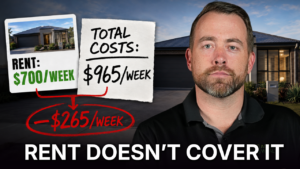
- 2Cash flow.For a lot of the investors we see, holding an established property costs around $700 a week out of pocket. For most families, that isn't realistic.
- 3Bad timing.Those repair bills tend to land when you can least afford them.
We've broken down what holding costs look like, with real numbers, in a worked example here.
Why we focus on new builds
We've done this for years, long before the tax rules started pushing investors away from established property. Since the 2026 Federal Budget, negative gearing is limited to new builds for any established property bought after 12 May 2026.
That combination is what lets you afford to hold the property for the long term, even when life gets hard. It's also why a shortage matters most for properties that add supply. We explain that in what the housing shortage means for investors.
Holding on is the entire game
The people who lose in property aren't the ones who buy in a soft market. They're the ones who are forced to sell in one. Buying in a soft market still carries risk, because values can keep falling, so the plan has to work even if they do.
That's why the better question isn't whether the market is over. It's this: can I buy something solid, in the right area, that I can comfortably hold no matter what the market does over the next few years? Get that right, with a finance structure and safety buffers built to last and a property researched properly, and the scary headline stops being a threat. It just becomes noise.
See whether property investment fits where you're at.
Start with a conversation — 15 minutes to talk through your goals and where you stand today. From there, our team helps you see what the first step toward building wealth through a property portfolio could actually look like.
This article is general information only, not financial, credit, tax or legal advice, and does not take into account your personal financial situation. Market figures describe whole cities and regions, not any individual property, and past performance is not a reliable indicator of future results. Speak with an appropriately licensed professional about how any of this applies to you.